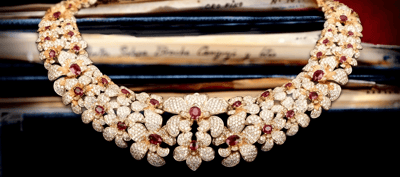
The Carrera y Carrera legacy
The history of Carrera y Carrera is, in many ways, the history of a family. A family united not only by blood ties, but by a deep love and respect for the art of jewelry. Over the years, we have worked side by side, sharing laughter, challenges and triumphs, always with the goal of creating something more than just luxury objects. We wanted to create art, pieces that not only embellished the wearer, but also told a story, conveyed an emotion and left an indelible mark over time.
Our designs, recognized worldwide for their originality and perfection, are the result of meticulous dedication and a constant search for perfection. Each piece of jewelry that leaves our workshop is the result of hours of craftsmanship, a combination of traditional and avant-garde techniques, and an attention to detail that borders on the obsessive. From the selection of the most exceptional gemstones to the final design, each step is carried out with a care and passion that has become our hallmark.
The founding partnersDiscover the talent, genius, and legacy of Carrera y Carrera's visionary founders who shaped our iconic brand.
- Manuel Carrera
- Antonio Calvo
- Carlos Mellado
- Juan José Carrera
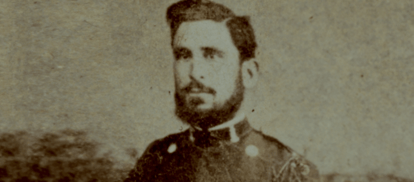
Saturio Esteban
The history of Carrera y Carrera dates back to the end of the 19th century, a period of great transformations for Madrid and, in general, for all of Spain. It was a time marked by political, social and economic changes that would significantly influence the future of the country. During this time, Spain underwent a process of modernization that, although slow and uneven, laid the foundations for a country that sought to integrate itself into the currents of progress that were already sweeping other European nations.
The wedding of King Ferdinand VII to María Cristina de Borbón-Nápoles brought a new air to the Spanish capital. Madrid began to adopt a more Parisian aesthetic, with the construction of wide boulevards, ornate squares and imposing buildings that sought to reflect the grandeur and splendor of a renewed monarchy. These urbanistic changes were part of an effort to modernize the city and bring it into line with the most advanced capitals of Europe. However, this period was also marked by political tensions and internal conflicts that defined the social landscape of the time.
Saturio Esteban, a young and talented jeweler originally from Alcalá de Henares, opened a small and humble jewelry workshop in the emblematic neighborhood of Las Letras, an area of Madrid that had been home to illustrious writers and artists of the Spanish Golden Age. This neighborhood, known for its bohemian spirit and cultural atmosphere, offered the perfect environment for an artisan passionate about his craft to flourish.
The exceptional quality of the pieces produced by Saturio soon attracted the attention of a select clientele, composed of members of Madrid's high society and European aristocracy visiting the capital. These early creations, which combined traditional craftsmanship with innovative style, quickly became a symbol of status and elegance. Saturio's workshop became a place of reference for those seeking exclusive and high quality jewelry, consolidating its reputation in a demanding and competitive market.
Saturio Esteban's success was not only a personal triumph, but also the beginning of a family tradition that would last for generations. His son, José Esteban, representing the second generation of the family, left for Paris in 1905 to perfect his skills as a lapidary. In the French capital, José immersed himself in the vibrant atmosphere of European jewelry, learning advanced gem-cutting techniques that would enrich his craftsmanship. For three years, he absorbed knowledge and experiences that not only transformed his technical prowess, but also his aesthetic vision and understanding of the international jewelry market.
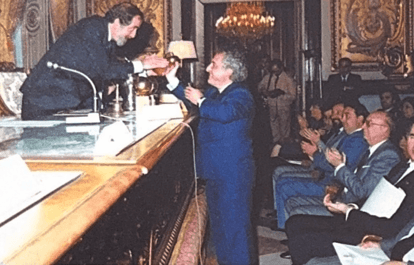
Manuel Carrera at Madrid Chamber of Commerce
Returning to Madrid in 1908, José Esteban began to apply his new knowledge and skills working for the country's leading jewelry firms. His experience in Paris had not only provided him with technical knowledge, but also a global perspective on the evolution of the jewelry art in Europe. In a Madrid that, although neutral during World War I, felt the distant echo of continental conflicts, José established his reputation as a renowned lapidary in a culturally rich and artistically vibrant environment, which allowed him to work for the most relevant brands of the time.
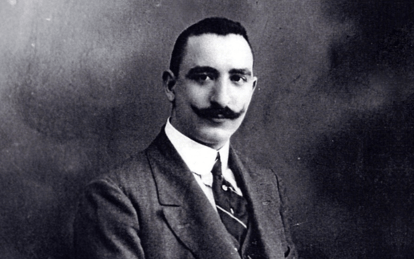
Jose Esteban, Saturio's son
During the 1930s, the secrets of the trade were learned by José Carrera, Saturio Carrera and Pedro Carrera, who represented the third generation of the family. Having no direct descendants, the sons of his sister Concepción, Esteban and Saturio Carrera, along with Pedro Carrera, were trained as apprentices in their uncle José's workshop.
The 1920s and 1930s in Spain were no obstacle to the Carrera family's dedication and commitment to excellence. As young apprentices gained experience and skill, the Carrera y Carrera workshop continued to thrive, adapting to the challenges of the times while keeping its artistic and ethical principles firmly rooted.
Spanish jewelry faced significant challenges due to economic and political fluctuations. The Great Depression severely impacted the global economy, affecting Spain as well. However, the demand for luxury jewelry continued, albeit more selectively. Spanish jewelers, including Carrera y Carrera, were forced to adapt to the changing economic circumstances, focusing their attention on quality and exclusivity to satisfy an increasingly demanding clientele.
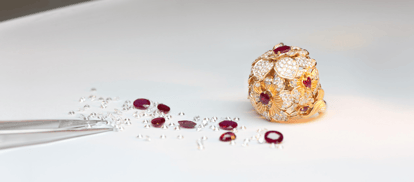
The Spanish Civil War (1936-1939) represented a devastating period for the country's jewelry industry. Many jewelry stores closed and production was drastically reduced. However, some companies such as Carrera y Carrera managed to maintain their operations, in part thanks to their ability to adapt and seek new markets abroad.
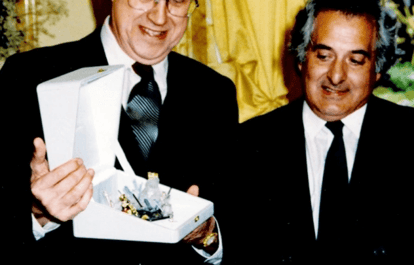
At International exhibitions
The 1940s marked a period of rebirth for Carrera and Carrera after World War II. Capitalizing on the growing demand for exclusive and sophisticated jewelry, the company expanded its distribution network by opening new points of sale in key cities in Europe and North America. This period of rebuilding and renewal was instrumental in consolidating the brand's presence in international markets.
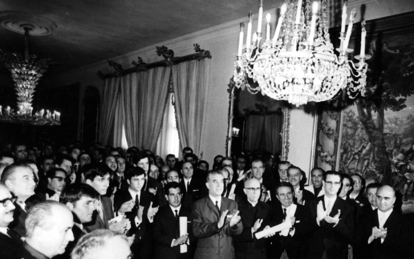
Manuel Carrera exhibiting. 1968. Paris
In the glittering 1950s, Carrera y Carrera not only emerged, but consolidated its position as a pillar of fine jewelry worldwide. This golden age marked a milestone in the company's history, catapulting it into emerging markets in Asia and the Middle East, where its exquisite creations found an audience eager for luxury and sophistication. The firm knew how to surround itself with fashion designers and iconic celebrities, multiplying its visibility and reinforcing its prestige among the global fashion and luxury elite. From its beginnings, Carrera y Carrera distinguished itself for its commitment to excellence and innovation, reaching new heights in the 1950s. The company began to explore new techniques and designs, resulting in pieces that were not only jewelry, but true works of art, attracting the attention of collectors and connoisseurs around the world, who valued the originality and craftsmanship of each creation.
The history of Carrera y Carrera in the 1950s is a testament to what can be achieved with vision, dedication and passion. From humble beginnings to becoming a world-renowned name, the company has come a long way. And although the jewelry world has changed a lot since then, the core values of Carrera y Carrera - quality, innovation and exclusivity - remain the same as those that have guided the company throughout its history and continue to be the key to its success today.
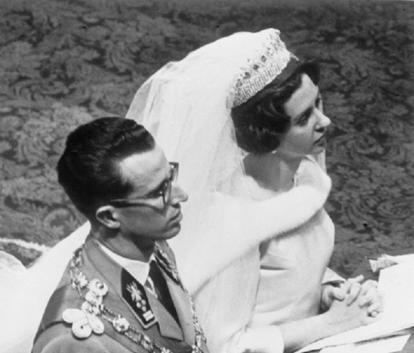
King Baudouin I of Belgium and Spanish aristocrat Fabiola of Mora y Aragón
It was precisely in this period when Carrera y Carrera emerged as one of the most prestigious jewelry workshops in Spain. Manuel Carrera, who years earlier had been reinforcing his artistic knowledge with the director of the School of Jewelry, Miguel Cruz Cuyalbé, created his first workshop in his family home, where the spirit of his previous generation of jewelers still existed. The small workshop was located in the traditional and historic neighborhood of Las Letras in Madrid, at 41 Santa María Street.
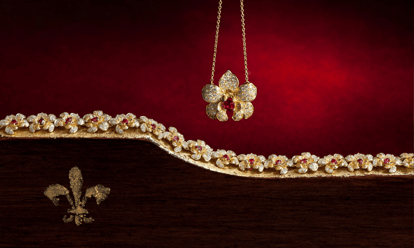
At the end of the 1960s and beginning of the 1960s, Carrera y Carrera was founded by Manuel Carrera, Juan José Carrera (Manuel's cousin), Antonio Calvo and Carlos Mellado. These were the beginnings of the brand as we know it today. The Carrera y Carrera concept was born, based on large pieces of a certain size, with a clearly artistic nuance, inspired by mythological or symbolic themes, using animal and human figures (mainly female) in their proposals. The materials usually used in his creations were yellow gold combined with diamonds and other precious stones, always trying to ensure that the metal part was the predominant one in order to show all its artistic essence.
From that moment on, Carrera y Carrera jewelry was chosen by numerous influential personalities of the time, including movie stars, royalty and aristocracy, who wore them at important events, consolidating its status as an internationally recognized luxury brand.
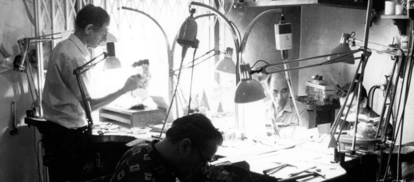
Manuel's Carrera workshop. 1965
The 1970s and 1980s witnessed significant changes in the world of jewelry, both in Spain and internationally. These years were characterized by a radical transformation in tastes, techniques and design trends, reflecting the social, political and economic dynamics of the time.
The great international jewelry houses adapted to these trends, creating collections that reflected the exuberance of the era. Eighties jewelry pieces were often characterized by their size and visual impact, with chunky necklaces, long earrings and striking bracelets that became symbols of status and wealth.
Another important achievement for Carrera y Carrera in that decade was participation in the most important jewelry fairs. In addition to attending the Iberjoya fair from its beginnings, fundamental for the firm's development in Spain, the internationalization of the company led to its participation in 1977 in the world's most important jewelry fair, Baselworld, held in Basel, Switzerland.
Carrera y Carrera knew how to adapt to new trends without losing its distinctive identity. The company continued to explore mythological and symbolic themes, using animal and human figures in their designs. The pieces, meticulously crafted in yellow gold and adorned with diamonds and other precious stones, stood out for their combination of tradition and modernity. The gloss/matte finishing technique, which became one of the hallmarks of the brand, allowed the creation of pieces with a unique depth and dynamism, transforming each piece of jewelry into a small work of art.
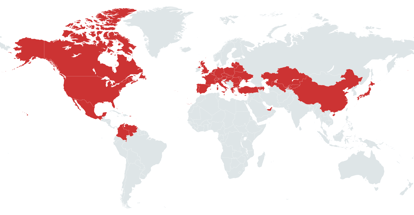
During the 1970s and 1980s Carrera y Carrera experienced a period of significant growth. The company managed to expand its presence in the national and international market, particularly in Asia, the United Arab Emirates and the United States, establishing commercial relationships with prestigious retailers.
In 1985 Carrera y Carrera presented the President of the United States, Ronald Reagan, with an allegorical sculpture made of silver and calcite, called “El Rodeo”, currently on display at the White House.
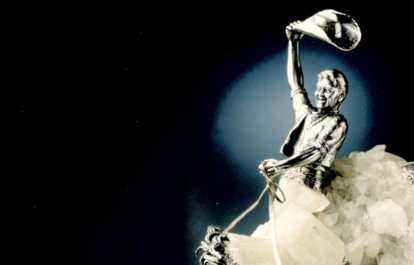
Sculpture “El Rodeo”. 1985
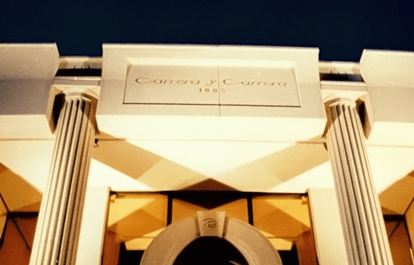
Old headquarters of Carrera y Carrera in San Agustin del Guadalix. 1992. Madrid
The 1990s were a time of globalization and economic growth for Spain. The country's entry into the European Union and the adoption of the euro facilitated international trade and the expansion of Spanish companies. Spanish jewelry benefited from these trends, as jewelry stores were able to access new markets and attract an international clientele.
The 1990s were especially important for Carrera y Carrera, marking milestones that reaffirmed its prestige and commitment to high-quality craftsmanship. A particularly memorable moment was the creation of the Arca del Quinto Centenario, a masterpiece designed to commemorate the 500th anniversary of the discovery of America. This unique work was presented at the Royal Palace in Madrid before Queen Sofia and in the presence of all the ambassadors of the Ibero-American countries, the United States and the United States and the Philippines. Subsequently, it was exhibited to the public at the Madrid City Hall, at the Universal Exposition of Seville in 1992 and at “The Hispanic Society of America” in New York.
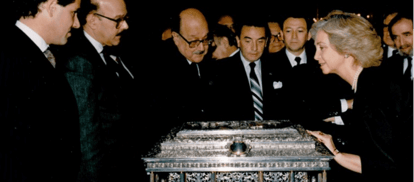
The Royal Spanish Family admiring the Carrera y Carrera's "The Arc of Discovery the Fifth Centennial". 1992. Madrid
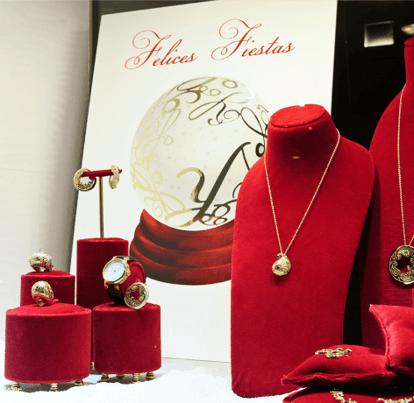
Coinciding with the turn of the century, Carrera y Carrera begins a new and ambitious stage of international expansion, which leads to the opening of brand boutiques in some of the most representative cities in the world, such as Madrid, Dubai, Kiev, Toronto, Tokyo, Bangkok, Kuala Lumpur and Macao. Carrera y Carrera boutiques, with their elegant and sophisticated design, became desired destinations for jewelry lovers around the world.
Miriam Ungría, Princess of Turnovo, joined the design team, while Antonio Calvo decided to leave the company to found another artistic jewelry brand.
2004The Lladró family joined the Carrera y Carrera investment group, managing to acquire 100% of the company in 2006 and then selling it to another investment group in 2010. In the second half of 2010, subsidiaries were opened in Japan, and in 2013 Carrera y Carrera opened its first boutique in China.
2010sThe 2010s were a time of change and challenges for Spanish jewelry. The global economic crisis of 2008 had a lasting impact on many industries, including jewelry. However, jewelry stores that were able to adapt to the new market realities found ways to innovate and grow.
2020sAfter the Covid 2019 crisis Carrera y Carrera went through a period of uncertainty that prompted a new change in ownership. In 2021 the company became part of a major international jewelry group, whose board of directors includes three of the sons of one of the previous owners, Antonio Calvo.
Back to the originUnder the slogan “Back to the origin” the team led by Daniel Calvo, as the highest creative authority, began a new stage with the purpose of recovering the unique and distinctive DNA responsible for the success experienced by the firm in its best moments.
This return to the origin represents the recognition of a unique and unmistakable style and at the same time a tribute to the savoir faire of the Spanish brand that revolutionized the world of jewelry with its daring and innovative designs.
The first collection designed by Daniel Calvo for Carrera y Carrera is committed to recovering the purest style of the house, the one with which it experienced its best moments. Artistic jewelry creations with a unique and distinctive character that managed to conquer the most demanding tastes and allowed the firm to cross borders and become recognizable worldwide.
Daniel, a lover of art deco style and classical sculpture, acknowledges feeling a special emotion to assume the creative direction of the firm to which his father dedicated so many years of his life, so, in this first collection, he has decided to recover the most representative icons of the brand in recognition of the legacy that was passed on to him.
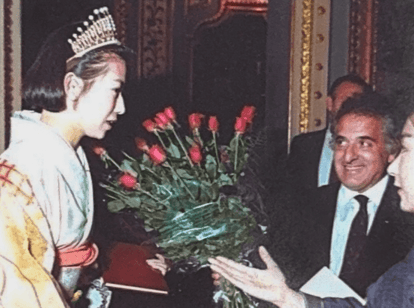
Carrera y Carrera has woven a rich and sophisticated narrative throughout its history, standing out as one of the most emblematic firms in the world of fine jewelry. Its close ties with royalty and celebrities have played an essential role in building its prestige and global recognition. The relationship with the Spanish Royal Family, in particular, has been a fundamental pillar in its trajectory.
One of the most emblematic commissions that consolidated Carrera y Carrera's prestige was the creation of the Sword of Victory. This project, full of symbolism and master craftsmanship, not only underscored the firm's technical skill, but also its ability to capture and reflect the essence of a historical moment.
In addition to its relationship with royalty, Carrera y Carrera has managed to capture the attention of some of the most influential and glamorous figures of the twentieth and twenty-first century. International celebrities such as Audrey Hepburn, Elizabeth Taylor and Grace Kelly, undisputed icons of cinema and fashion, have worn its exquisite creations, taking the name of the brand to unsuspected corners of the planet. These jewels, selected for their distinctive design and incomparable quality, have been the stars of red carpets, photo shoots and prestigious events, leaving an indelible mark on the history of fashion.
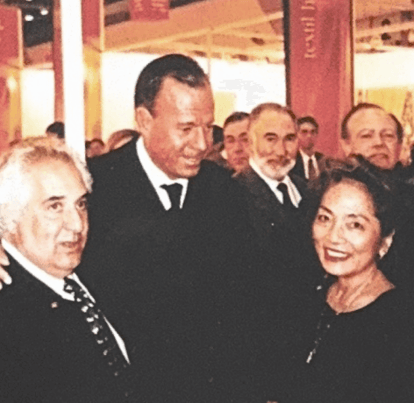
The influence of Carrera y Carrera does not stop with the stars of the past. Contemporary figures such as Madonna, Jennifer Lopez or Taylor Swift, recognized for their bold style and magnetic presence, have opted for the firm's jewelry, confirming its continued relevance in the changing world of luxury.
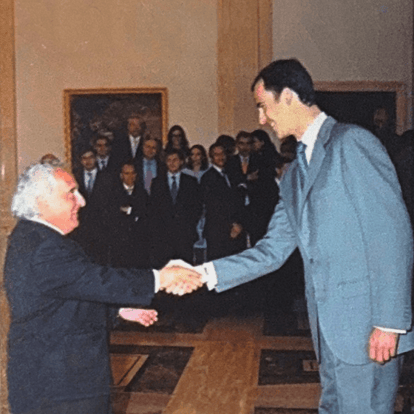
The relationship between Carrera y Carrera and the Spanish Royal Family goes beyond jewelry and into a realm of mutual respect and admiration. The constant support and recognition of the royals has not only validated the quality and dedication of the brand, but has also served as a powerful testimony to its ability to endure and prosper over time.
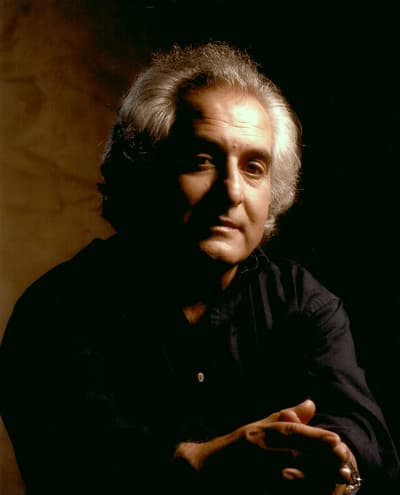
Manuel Carrera, born in 1940, is a direct descendant of the Carrera jewelers, specialists in gemstone cutting. From a very young age, he felt a deep passion for the traditional family trade. During his youth, the Spanish jewelry industry was going through a period of crisis, exacerbated by the Republic and the hardships of the war and its aftermath, which severely impacted the sector.
At fourteen, Manuel began his training in the jewelry workshop of José María Rico, thanks to the help of his uncle Esteban. This workshop worked for the renowned Sanz jewelry firm, and Manuel remained there as an apprentice for two years. He then continued his apprenticeship in the workshop of Ignacio Cruz de la Rosa, Master Jeweler of Madrid, for another two years. During this time, Manuel also attended the Madrid Trade Union School of Jewelry, where he complemented his practical training with theoretical studies.
His apprenticeship culminated in a valuable experience in the workshop of Juan Gómez Pavón, where jewelry making was considered one of the most artistic crafts. At this stage, jewelry was heavily influenced by traditional and antique styles. However, when Manuel turned twenty-two, he decided to strike out on his own and began developing a very different kind of artistic production.
In 1964, Manuel embarked on a series of trips that allowed him to innovate and experiment in the field of jewelry sculpture. These experiences were fundamental to the creation of a new style within the jewelry industry. He formed a core management team that included José Carrera, Juan José Carrera, Antonio Calvo, and Carlos Mellado. Although each team member had their own style, they understood that, to establish themselves nationally and internationally, it was essential to follow a distinctive and differentiating path.
Manuel's artistic vision and innovative spirit transformed the jewelry landscape of his time. Through his travels, he absorbed diverse influences and techniques that he applied to his creations, setting them apart from conventional styles. This new perspective allowed his company not only to survive in a challenging market but also to stand out and consolidate its position both nationally and internationally.
Manuel Carrera was not only a design innovator but also the face of the brand for many years. He traveled the world as a brand ambassador, forging relationships with celebrities and prominent figures. His ability to connect with influential figures in fashion and high society was crucial to the company's growth and international reach.
Adaptability and a constant pursuit of originality were key to the success of Manuel and his team. The management team, comprised of individuals with diverse yet complementary perspectives, successfully integrated their differences and worked together toward a common goal: creating a unique style and standing out in the competitive world of jewelry.
Manuel Carrera's story is an inspiring example of how passion, talent, and innovation can transform a family tradition into a renowned company. Despite adversity, he overcame challenges and triumphed in a changing and demanding environment, leaving an indelible mark on the world of fine jewelry.
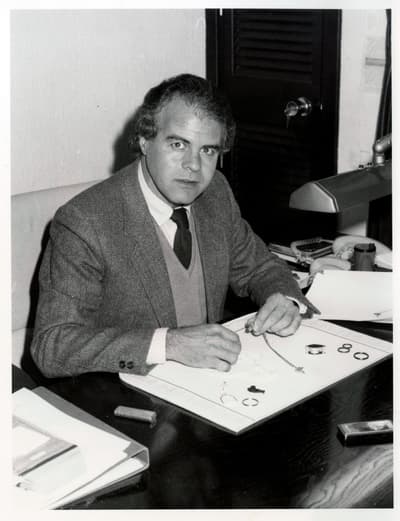
Antonio Calvo Isla, co-founder of the prestigious jewelry house, had a life story marked by hard work and dedication from a very young age. Born in 1945 into humble circumstances, he began working in a small carpentry shop in Plaza de Santa Ana, in the heart of Madrid. His inclination towards manual labor and his desire to learn were evident from a young age. At 14, after finishing primary school, he enrolled in a vocational institute in Cruz de los Caídos, where he excelled with exceptional grades while completing internships in carpentry, electricity, and mechanics. He dedicated his afternoons to a technical drawing academy, where, despite the limitations of his teacher, who had lost an arm in the Spanish Civil War, Antonio stood out remarkably.
Antonio's life began to change when, working as an errand boy for a jewelry store in Plaza de Santa Ana, his drawing skills caught the eye, and he began sketching rings and other jewelry pieces. It was in this environment that he discovered a jewelry school in the Ópera district, which he began attending in the evenings. After two years of night classes, he decided to look for a workshop where he could gain more hands-on experience. At 16, he started as an apprentice in a small workshop, where he learned more than the school could offer, working overtime to hone his skills. At 18, Antonio moved to a larger workshop in Plaza Mayor. He joined as a third-class craftsman and soon began creating pieces for a luxury clientele in exclusive areas like Gran Vía and Serrano. It was in this workshop that he met an apprentice who told him about Manuel Carrera's workshop on Calle Atocha.
The prospect of working with Manuel led him to join his workshop, where he quickly rose to head of the workshop, overseeing the design and production of jewelry. Meanwhile, Manuel focused on public relations and acquiring clients.
After five years of fruitful collaboration, Antonio considered striking out on his own. However, Manuel, recognizing his talent and value, proposed a partnership. Thus, the "Mantuan" workshop was born, a French-inspired combination of "Manolo" and "Antonio." Given the workshop's growing success, they understood the need to join forces, and it was then that Juan José Carrera, Manuel's cousin and a shrewd businessman, joined them.
Thus, in 1970, the company that would become synonymous with luxury and excellence was born: Carrera y Carrera. Antonio Calvo Isla was in charge of design and production, Manuel Carrera managed public relations, and Juan José Carrera handled sales. The workshop, located on Calle Santa María between Paseo del Prado and the Palace Hotel, employed around 20 people, a considerable number for the time and marking the beginning of a firm that, over time, would become a global benchmark in the world of fine jewelry.
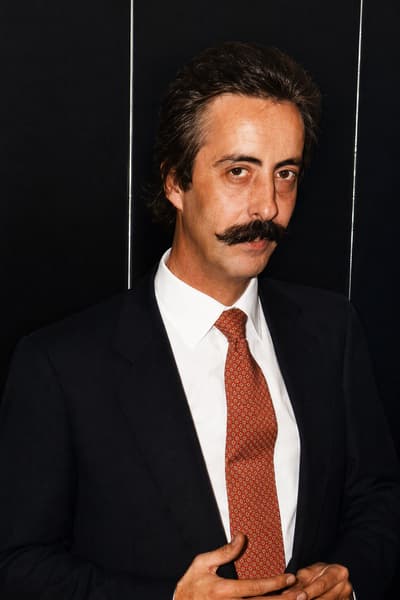
Carlos Mellado was a great designer who, throughout his career, distinguished himself by his ability to fuse traditional elements with modern innovations, creating jewelry that was true works of art. From a young age, Carlos displayed an innate talent for design and a deep passion for the arts. This talent and dedication led him to become one of the most talented designers of his generation, capturing the attention of many in the fashion and jewelry industries with his unmistakable style and meticulous attention to detail.
The pinnacle of his career came when he was invited to join Carrera y Carrera, one of the most prestigious and internationally renowned jewelry firms. Carlos Mellado's arrival at the company marked a new chapter in its history, as his vision and creativity added a new level of sophistication to the brand's collections. As a partner at Carrera y Carrera, Carlos played a crucial role in the development of some of the firm's most iconic collections.
His designs reflected a profound understanding of nature and mythology, recurring elements in Carrera y Carrera pieces. Under his creative direction, the company continued to solidify its reputation as a leader in the world of fine jewelry, attracting a select and discerning clientele who valued both the beauty and quality of its creations. Carlos Mellado's influence was fundamental in helping the brand reach new levels of prestige and international recognition.
Sadly, the world of jewelry lost one of its brightest stars with the untimely death of Carlos Mellado in 2016. His passing left a void at Carrera y Carrera and in the design industry as a whole. However, his legacy lives on through the magnificent pieces he created, which continue to be celebrated for their beauty and originality. Carlos Mellado's designs remain a source of inspiration and admiration, and his influence is felt in every new Carrera y Carrera collection, perpetuating his memory and his invaluable contribution to the art of jewelry.
With this book, we wish to pay tribute to his art and the indelible mark he left on the world of fine jewelry. Carlos Mellado was not only an exceptional designer, but also a visionary whose work continues to inspire future generations of artists and jewelers. His dedication and passion for design live on in every piece he created, reminding us of the importance of innovation and beauty in our lives.
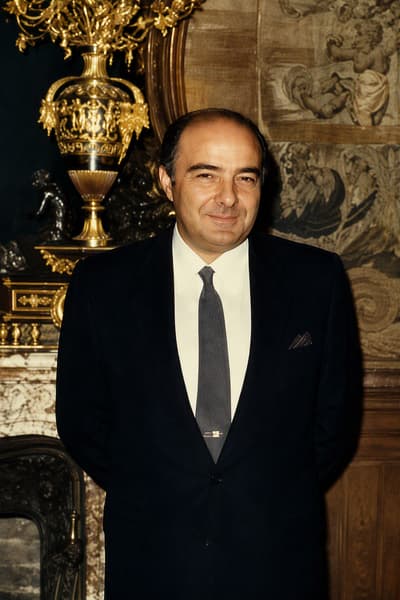
Juan José Carrera, cousin of Manuel Carrera, played a pivotal role in the creation and success of the prestigious jewelry brand Carrera y Carrera. As one of the founding partners, Juan José contributed his remarkable business skills, which proved to be an invaluable asset to the company from its earliest days.
From the outset, Juan José Carrera applied his experience and talent in the commercial field to support the company's growth and expansion. His deep understanding of the markets and his ability to identify business opportunities were key to establishing a solid foundation in the competitive jewelry sector.
One of Juan José Carrera's greatest achievements was his decisive contribution to the internationalization of the brand. Recognizing the potential for expansion beyond Spain's borders, Juan José used his expertise in international trade to open new markets and establish strategic alliances in various regions of the world. This approach not only increased sales but also raised Carrera y Carrera's profile on the global luxury jewelry scene.
Under his leadership and strategic vision, Carrera y Carrera's exquisite jewelry reached an international clientele of enthusiasts and collectors of unique, high-quality pieces. His ability to navigate foreign markets and position the brand in key fashion and luxury cities, such as New York, Paris, and Tokyo, was fundamental to Carrera y Carrera's global recognition.
Beyond his impact on the business side, Juan José Carrera played a crucial role in strengthening the brand's identity. Working closely with renowned designers like Carlos Mellado, Juan José ensured that Carrera y Carrera's essence and distinctive style remained intact as the company grew and expanded into new markets.
In short, Juan José Carrera was not only a founding partner of Carrera y Carrera, but also a key architect in the brand's development and international expansion. His business acumen and strategic vision left an indelible mark on Carrera y Carrera's history, solidifying its reputation as one of the most prestigious and respected jewelry firms worldwide. His legacy endures as an example of how talent and determination can take a brand from its inception to success.